


By Abdülaziz KAŞİFOĞLU
For many years, the energy bill has been one of the most significant structural weaknesses of the Turkish economy.
Türkiye is a large industrial and residential economy, yet it remains heavily dependent on imported oil and natural gas to meet its energy needs. This means that rising global oil and gas prices do not simply increase fuel costs; they can also put pressure on the current account, the foreign exchange market, inflation, production costs, and the competitiveness of industry.
For this reason, what is happening in Türkiye’s energy sector today goes far beyond a collection of separate projects.
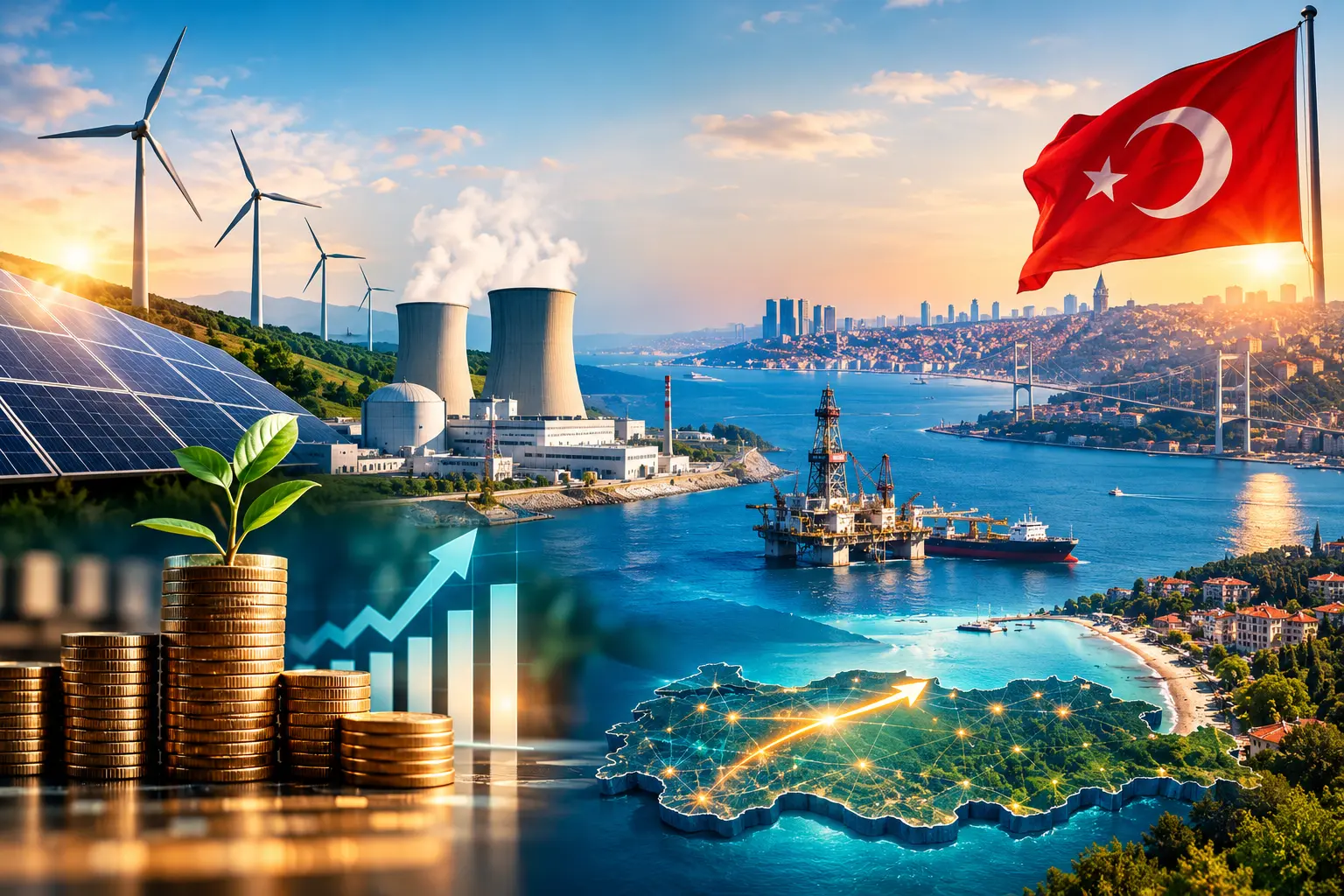
Natural gas production in the Black Sea, the Akkuyu Nuclear Power Plant, the expansion of solar and wind energy, and investments in energy grids and infrastructure are all parts of a broader economic transformation: reducing the Turkish economy’s vulnerability to imported energy.
Here, it is important to be precise:
Türkiye has not yet achieved full energy sovereignty and remains heavily dependent on energy imports.
However, it is gradually moving towards reducing this dependence. This alone could become one of the most significant economic transformations of the coming decade.
1. Why Is Energy an Economic Issue, Not Just a Strategic One?
When a country imports large quantities of oil and natural gas, it must continually obtain foreign currency to pay for these imports.
In Türkiye’s case, the country has a substantial industrial base and requires energy to operate factories, transport systems, and buildings. As a result, increases in global energy prices can quickly affect the economy.
The process can be simplified as follows:
- Rising oil and natural gas prices
- A higher energy import bill
- Increased demand for foreign currency
- Greater pressure on the current account and foreign exchange market
- Higher production and transportation costs
- Inflationary pressures
- Higher financing costs and a greater need for tighter monetary policy
For this reason, increasing domestic energy production does not simply mean supplying more gas or electricity.
It can also mean reducing one of the Turkish economy’s sources of external vulnerability.
2. Black Sea Natural Gas: The Beginning of Real Change
One of the most important developments in this area is the development of the Sakarya natural gas field in the Black Sea.
Türkiye’s domestic natural gas production is gradually expanding as new wells and additional phases of the project come online. The objective is not merely to produce gas, but also to build an increasingly strong national capacity to extract and process natural gas from the Black Sea.
This is where the project’s economic significance becomes clear.
Every cubic metre of gas produced domestically can, under certain conditions, mean a corresponding reduction in the amount of gas Türkiye needs to import.
This can lead to:
- Higher domestic production
- Lower imports
- Less pressure on foreign currency
- A relative improvement in the current account
- Reduced vulnerability to fluctuations in global natural gas prices
However, it is also important not to exaggerate the potential impact.
Even if production at the Sakarya field reaches higher levels, Türkiye will continue to need to import a substantial portion of its natural gas requirements for many years.
The realistic objective, therefore, is not to eliminate natural gas imports altogether, but to reduce dependence on them and make the economy more resilient to energy shocks.
This is a very important distinction.
3. Akkuyu: Nuclear Power Enters the Equation
Another project that could change the structure of Türkiye’s energy system is the Akkuyu Nuclear Power Plant.
Nuclear energy differs from oil and natural gas in one fundamental respect:
It requires substantial upfront capital investment, but it can generate electricity reliably over an extended period, with less reliance on fossil fuels for electricity generation.
As Akkuyu’s units gradually enter operation, Türkiye will gain an additional source of baseload electricity.
This is important because heavy industries, data centres, factories, and modern infrastructure all require a stable and reliable electricity supply.
As the digital economy and higher-value-added industries expand, energy security and electricity reliability become integral to the country’s competitiveness.
4. Natural Gas Alone Will Not Be the Solution
It would be a mistake to view the future of Türkiye’s energy sector as a project involving only natural gas and nuclear power.
A genuine energy transition requires a diversified mix of energy sources.
Türkiye has significant potential in:
- Solar energy
- Wind energy
- Hydropower
- Domestic natural gas
- Nuclear energy
- Energy storage
- Electricity grid modernisation
This diversity is extremely important.
The more diversified an energy system is, the less vulnerable it becomes to a shock affecting any single source.
If global natural gas prices rise, Türkiye will be less exposed if a larger share of its electricity comes from diverse domestic sources.
Similarly, if solar technology becomes cheaper or energy storage technologies improve, Türkiye can increase its capacity to generate electricity domestically.
The question, therefore, is not:
Natural gas, nuclear power, or solar energy?
It is:
How can Türkiye build an energy mix that makes its economy more resilient to shocks?
5. The Potential Impact on the Turkish Lira
This is a particularly important issue for investors.
It would be incorrect to claim that natural gas production or the operation of a nuclear power plant will automatically strengthen the Turkish lira.
The exchange rate is influenced by numerous factors, including:
- Inflation
- Interest rates
- Foreign exchange reserves
- Capital flows
- The current account
- Market confidence
- Monetary policy
- Fiscal policy
- Global developments
However, energy can influence one particularly important factor: the current account and demand for foreign currency.
Increasing domestic energy production could therefore help reduce one of the structural sources of demand for foreign currency. It could also make the economy less vulnerable to shocks in global energy prices.
This could support macroeconomic stability over the medium and long term, provided it is accompanied by continued monetary and fiscal discipline.
6. Will Energy Production Reduce Inflation?
The answer requires a degree of precision.
Energy is an important source of cost pressures across the economy, but it is not the only factor and cannot be regarded as the sole or principal cause of inflation in Türkiye.
Inflation is also affected by:
- Monetary policy
- Credit growth
- The exchange rate
- Wages
- Domestic demand
- Inflation expectations
- Food prices
- Production costs
- Fiscal policies
Nevertheless, greater domestic energy production could help ease some pressures on energy and production costs, particularly if Türkiye succeeds in increasing the share of domestic and renewable energy in its overall energy mix.
This is where the impact could become more significant over the long term.
7. The Impact on Turkish Industry
The industrial sector could be among the biggest potential beneficiaries.
Türkiye competes in markets such as:
- Automotive
- Iron and steel
- Cement
- Glass
- Petrochemicals
- Household appliances
- Textiles
- Defence industries
- Engineering industries
In many of these sectors, energy represents a significant share of production costs.
Building a more stable energy system that is less exposed to import-related shocks could therefore help Turkish companies plan and invest more effectively.
This brings us to another important point concerning Europe.
8. Clean Energy and the European Union
Türkiye is closely integrated economically with the European Union.
As Europe gradually moves towards stricter policies on carbon emissions, the cost of carbon has become an increasingly important factor in export competitiveness.
Increasing electricity generation from low-carbon sources, such as nuclear, solar, and wind energy, could therefore help Turkish companies reduce the carbon intensity of their production processes.
This does not mean that clean energy automatically exempts exports from European carbon charges.
Rather, it can help Turkish companies improve their competitiveness in a European trading environment that is increasingly moving towards carbon pricing.
This is a particularly important strategic consideration.
9. What About Foreign Investment?
Foreign investors do not look only at interest rates or property prices.
They assess the broader economic picture:
Is the economy stable?
Is energy readily available?
Is the infrastructure strong?
Are production costs predictable?
Does the country have an industrial base?
Is the domestic market large?
Are export opportunities available?
From this perspective, increasing domestic energy production could become a supporting factor in attracting long-term investment, particularly industrial investment that requires substantial amounts of energy.
This could make Türkiye more attractive as a production and export hub connecting Europe, Asia, and the Middle East.
10. Energy, the Lira, and Real Estate: What Is the Connection?
This point is particularly important to me when considering the future of Türkiye’s real estate market.
There is a potential economic chain of developments worth monitoring:
Higher natural gas production + nuclear power + solar and wind energy
This could lead to:
- Reduced dependence on imported energy
- Improved resilience in the current account
- Lower vulnerability to energy price shocks
- Gradual improvements in economic stability, provided monetary and fiscal policies support this process
- Lower inflation over time
- The possibility of lower interest rates when economic conditions permit
- Lower financing costs
- Increased investment and production
- Stronger demand in areas experiencing genuine economic and population growth
This is where the real estate story begins.
11. Why Could Istanbul, Yalova, and Other Regions Benefit?
This does not mean that all properties will appreciate at the same rate.
This is a crucial point.
Real estate prices are not driven solely by inflation or interest rates.
A property with strong investment fundamentals is one supported by genuine economic factors, including:
- Population growth
- Infrastructure development
- Roads and transportation links
- Industrial activity
- Tourism
- Universities
- Public and commercial services
- Employment opportunities
- Proximity to major cities
- Genuine housing demand
For this reason, regions such as Istanbul, Yalova, Mersin, and other areas can be viewed from a different perspective.
Istanbul remains Türkiye’s largest economic and financial centre. Yalova, meanwhile, enjoys a significant geographical advantage thanks to its proximity to Istanbul, its location on the Sea of Marmara, and its connections to transportation networks, ports, industrial zones, and tourism destinations.
This means that the future of Yalova’s real estate market is linked not only to rising property prices, but also to the region’s growing economic value.
This is the kind of investment that deserves careful consideration.
12. Yalova: From a Real Estate Market to a Part of the Marmara Economy
When discussing Yalova, we should not view it merely as a beautiful coastal city.
What matters more is its position within one of Türkiye’s most important economic regions.
The Marmara region accounts for a substantial share of the country’s industrial, commercial, and logistics activities.
Yalova is located close to:
- Istanbul
- Bursa
- Kocaeli
- Ports
- Industrial zones
- Maritime and land transportation routes
This gives the city a strategic advantage.
If Türkiye continues to develop its infrastructure, transportation networks, energy sector, and industry, areas connected to the wider Marmara network could benefit from expanding economic activity.
In this context, real estate becomes a potential outcome of economic growth rather than merely an asset subject to speculation.
13. Is a Reduction in Interest Rates Alone Enough to Push Property Prices Higher?
No.
This is one of the most important points investors need to understand.
Lower interest rates can:
- Reduce financing costs
They can also increase:
- The ability of buyers to purchase property
And potentially lead to:
- Higher demand
However, the ultimate outcome depends on several other factors.
If interest rates decline because inflation is improving and the economy is becoming more stable, this represents a relatively positive scenario.
If interest rates fall while inflation rises sharply and the currency loses stability, however, the situation could be entirely different.
Therefore, the best-case scenario for the real estate market is not simply:
Lower interest rates.
It is:
Lower inflation + a more stable currency + lower interest rates + economic growth + balanced credit conditions + genuine demand.
This is the combination investors should monitor.
14. Are We Witnessing a Long-Term Economic Transformation?
In my view, this is the real question.
Türkiye is not simply trying to produce more natural gas.
It is not merely building a nuclear power plant.
Nor is it simply expanding solar and wind energy.
Rather, it is attempting to address one of the most significant structural weaknesses in its economy:
Heavy dependence on imported energy.
If Türkiye succeeds in gradually reducing this dependence, the impact will extend well beyond the energy sector.
It could influence:
- The current account
- The currency
- Inflation
- Interest rates
- Investment
- Industry
- Employment
- Real estate
However, this scenario is not guaranteed.
Success will require continued investment, improved energy efficiency, modernised electricity grids, increased domestic production, sustained monetary and fiscal discipline, and an investment environment capable of attracting long-term capital.
Conclusion
Perhaps the most important development in Türkiye’s energy sector today is not the number of billions of dollars being invested in any single project.
The real significance lies in the gradual transformation of the country’s economic equation.
A Türkiye that imports a substantial share of its energy needs is naturally more exposed to external shocks.
By contrast, a Türkiye that produces more natural gas, incorporates nuclear power into its energy mix, expands solar and wind generation, and develops its electricity grids and energy storage capacity is building an economy better equipped to withstand shocks.
This does not mean that Türkiye has become energy self-sufficient.
Rather, it means that the country is moving in the right direction towards reducing its dependence on external sources.
From this perspective, the energy sector could become one of the most important drivers of the Turkish economy in the coming years.
If Türkiye succeeds in gradually reducing its energy import bill, continues to bring inflation down, and improves its financing and investment environment, we could see a new economic cycle emerge—one in which energy, investment, industry, infrastructure, and real estate become interconnected parts of a broader story.
For real estate investors, the more relevant question is no longer:
“Will property prices rise?”
It is:
“Which regions will benefit most from the genuine economic growth Türkiye creates over the coming decade?”
This is precisely why cities and regions such as Istanbul and Yalova deserve close attention—not only because of their property prices, but also because of their position within Türkiye’s emerging economic and investment landscape.
A strong real estate future is not built on inflation alone, but on a stronger economy, better infrastructure, more secure energy supplies, and genuine investment.



Join The Discussion