


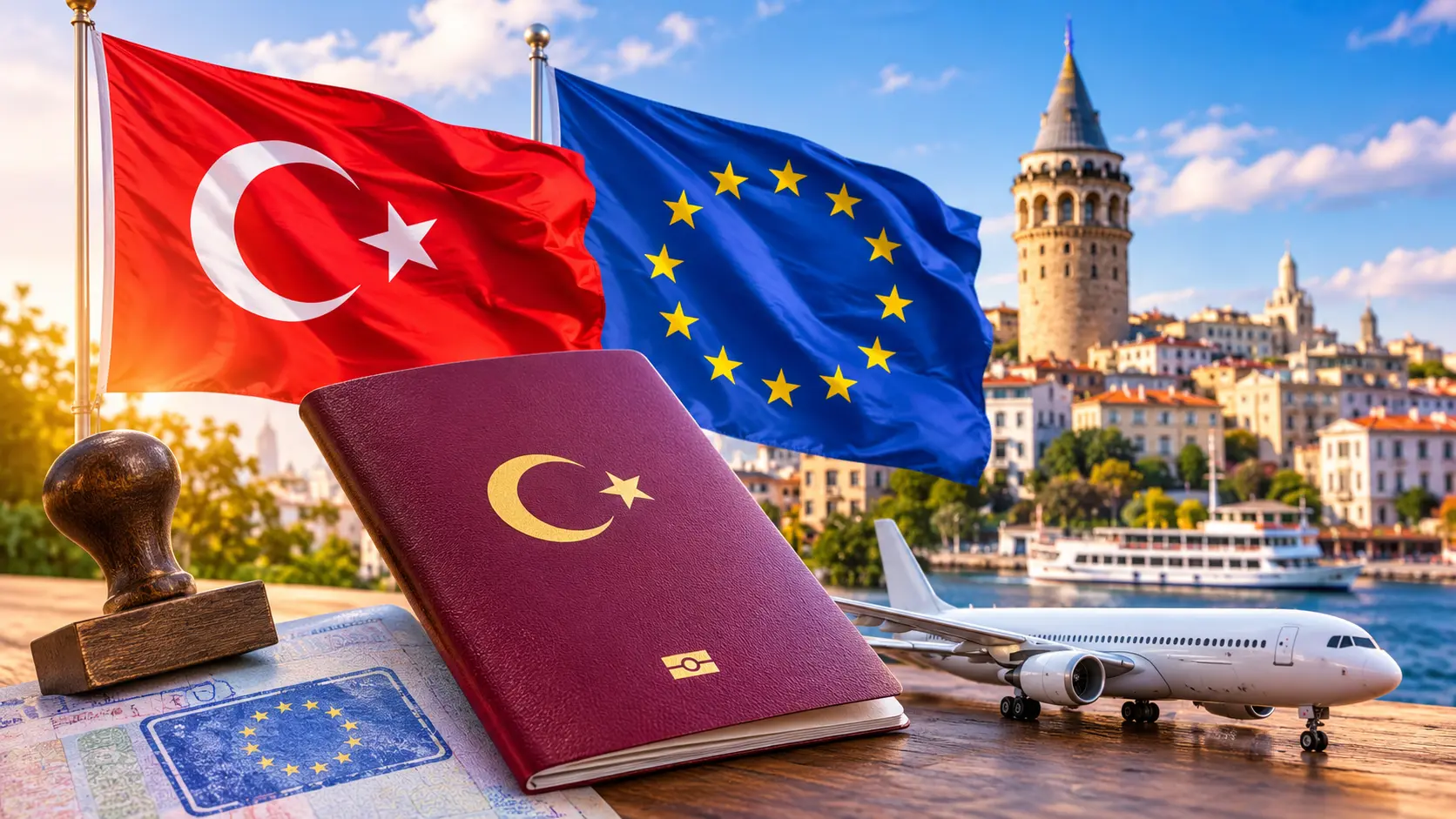
Comprehensive Analytical Report | November 20, 2026
By: Abdülaziz Kaşifoğlu
After many years of waiting and difficulties faced by Turkish citizens in obtaining Schengen visas, the issue of visa-free travel to Europe for Turkish nationals has returned to the forefront of discussions, following renewed diplomatic efforts between Ankara and Brussels.
Recent statements by Turkish Foreign Minister Hakan Fidan have attracted particular attention. He indicated that the final legislative drafts concerning the six remaining requirements for visa liberalization are nearing completion.
These developments have coincided with a renewed Turkish initiative calling on the European Union to facilitate Schengen visa procedures, reduce waiting times, increase appointment availability, and ease documentation requirements. A new working group has also been established to review the visa-related difficulties experienced by Turkish citizens.
However, the most important question on the minds of millions of Turkish citizens and residents in Türkiye is: Are we witnessing the beginning of a genuine process toward eliminating Schengen visa requirements for Turkish citizens, or are these developments still merely political initiatives and negotiations that could take several more years?
To answer this question, it is necessary to examine the issue from all angles, beginning with the history of Türkiye–European Union negotiations, continuing with the six remaining requirements, and concluding with the latest developments in November 2026 and what may happen in the coming period.
1. How Did the Story of Schengen Visa Exemption for Turkish Citizens Begin?
The issue of visa exemption for Turkish citizens is not new. It dates back to 2013, when Türkiye and the European Union launched an official visa liberalization dialogue alongside the signing of the Readmission Agreement concerning irregular migrants.
The objective of this dialogue was to enable Turkish citizens holding biometric passports that meet the required standards to travel to Schengen Area countries for short stays without obtaining a visa in advance.
These visits include:
- Tourism and leisure.
- Visiting relatives and friends.
- Business meetings and commercial activities.
- Other short-term visits permitted under the applicable rules.
The European roadmap initially included 72 requirements that Türkiye had to fulfill before visa-free travel could be introduced.
Over the years, the European Commission announced that Türkiye had fulfilled 65 of the 72 requirements. Following confirmation that a requirement concerning second-generation passports had also been fulfilled, the number of outstanding requirements was reduced to six.
Since then, the process has remained stalled because of disagreements over certain security, legal, and political issues.
The importance of this agreement goes beyond facilitating tourism. It represents one of the key issues in relations between Türkiye and the European Union, alongside the modernization of the Customs Union, security cooperation, migration, and Türkiye’s EU accession process.
Source: Turkish Directorate for EU Affairs – ab.gov.tr
2. What Are the Six Remaining Requirements Preventing Turkish Citizens from Obtaining Schengen Visa Exemption?
This is the most important part of the entire issue.
Although Türkiye has fulfilled most of the required conditions, the six remaining requirements continue to represent the main obstacle to reaching a final agreement on visa exemption.
These requirements fall under five main areas identified in the European roadmap: document security, migration management, public security and order, fundamental rights, and the readmission of irregular migrants.
The main issues that still require attention include:
1. Counterterrorism and Related Legislation
The European Union wants Türkiye’s counterterrorism legislation to become more aligned with European standards, particularly regarding the definition of criminal offenses and safeguards for fundamental rights and freedoms.
This is one of the most sensitive issues, as it reflects differences between Ankara and certain European capitals regarding the balance between national security and individual freedoms.
2. Personal Data Protection
Türkiye needs to complete the alignment of its personal data protection legislation with European standards, ensuring an adequate level of legal protection when personal information is exchanged.
This issue is particularly important because cooperation between Turkish and European security agencies involves the exchange of sensitive information.
3. Cooperation with the European Union Agency for Law Enforcement Cooperation (Europol)
Another key requirement is the conclusion of an agreement allowing the exchange of personal data between Europol and the relevant Turkish authorities responsible for combating serious crime and terrorism.
The European Union considers this an important element of the security cooperation framework that must be established before visa exemption can be granted.
4. Alignment of Türkiye’s Visa Policy with European Union Policy
The European Union wants Türkiye to revise certain rules governing the issuance of visas to citizens of other countries so that they become more consistent with the EU’s lists of visa-exempt and visa-required countries.
This requirement also includes reviewing the procedures for issuing electronic visas and visas on arrival.
5. Cooperation on the Readmission of Irregular Migrants
The original agreement between Türkiye and the European Union is closely linked to cooperation on the readmission of people who enter irregularly, in accordance with the agreed legal conditions and obligations.
6. Completing Security, Judicial Cooperation, and Fundamental Rights Requirements
The remaining requirements also include judicial cooperation in criminal matters, combating organized crime and corruption, protecting fundamental rights, and certain obligations related to migration management and travel documents.
It is important to clarify that these issues do not necessarily represent six separate laws. Rather, they constitute a set of legal and operational standards that must be assessed and fulfilled.
According to the European Commission’s report published on November 4, 2026, Türkiye made no progress in fulfilling the six remaining requirements during the period covered by the report.
This means that achieving visa exemption still requires practical steps rather than political announcements alone.
Source: European Commission Report – November 4, 2026 – eur-lex.europa.eu
3. Hakan Fidan’s Statement: Has Türkiye Come Closer to Resolving the Issue?
An important development took place on November 19, 2026, when Turkish Foreign Minister Hakan Fidan addressed the Planning and Budget Committee of the Turkish Parliament during discussions on the Ministry of Foreign Affairs’ 2027 budget.
Fidan stated that the permanent solution to the visa problem lies in implementing the Visa Liberalization Agreement with the European Union.
He added that Türkiye’s work on the six remaining requirements had reached the final stage of preparing the legislative drafts, and that these drafts would be submitted to Parliament after the budget discussions were completed.
This statement is important for three reasons:
First: The process is moving toward a more serious legislative stage.
Rather than relying solely on negotiations and diplomatic contacts, the Turkish government is now discussing legislative drafts that are expected to be presented to Parliament.
Second: There is an official commitment to addressing the six remaining requirements.
Fidan’s statement indicates that the Turkish government intends to reactivate issues that have remained unresolved for years and develop a framework that can be presented to the European side.
Third: The final solution remains dependent on a European decision.
Even if Türkiye adopts the required legislation, this does not mean that visa exemption will automatically come into effect. European institutions must first assess whether Türkiye’s measures comply with the required standards.
Fidan also stated that the acceptance rate of Turkish visa applications in 2023, 2024, and 2025 reached 85.4%, explaining that approximately 15 out of every 100 applications were not approved.
This demonstrates that the problem is not limited to visa refusals. It also involves difficulties in obtaining appointments, lengthy procedures, and the short validity periods of some issued visas.
Source: Grand National Assembly of Türkiye – tbmm.gov.tr
4. The November 18, 2026 Meeting: What Did Türkiye Request from the European Union?
Alongside the Foreign Minister’s statements, a meeting of the Local Schengen Cooperation Group (LSC) was held in Ankara on November 18, 2026.
The meeting brought together representatives of Schengen countries based in Türkiye, officials from the Turkish Ministry of Foreign Affairs, representatives of the EU Delegation, and the European Commission.
One notable aspect of the meeting was the participation of representatives from the Turkish Ministry of Foreign Affairs and the European Commission at this level for the first time, according to published reports.
During the discussions, Ankara presented several requests that it considers necessary to improve the experience of Turkish citizens applying for European visas.
The main Turkish demands can be summarized as follows:
1. Resolving the Visa Appointment Crisis
Many Turkish citizens face difficulties finding suitable appointments to submit their visa applications. Some applicants are forced to wait for long periods before they can even submit their documents.
Türkiye called for greater appointment availability, improved appointment allocation procedures, and measures to prevent practices that exploit applicants by charging excessive fees for appointments.
2. Accelerating Visa Application Processing
Ankara wants to reduce the time consulates take to review applications and issue decisions, particularly for applicants with clear travel purposes and a good previous travel record.
3. Reducing the Number of Required Documents
Another important demand is to review the documentation required from applicants and avoid requesting additional documents that may not be necessary in certain cases.
Türkiye believes that repeated document requests and complicated procedures place significant burdens on citizens, businesses, and students.
4. Facilitating Procedures for Applicants with Good Travel Records
Türkiye emphasized the need for easier treatment of individuals who have previously obtained Schengen visas, complied with their conditions, and have no recorded violations.
This demand is directly connected to the Cascade Visa Regime, which will be discussed in detail later.
5. Increasing the Issuance of Multiple-Entry Visas
Türkiye wants to expand the issuance of multiple-entry visas with longer validity periods, rather than requiring citizens to submit a new application before every trip to Europe.
This is particularly important for businesspeople, employees, students, and individuals with family members living in European countries.
6. Resolving Problems Faced by Turkish Truck Drivers
The meeting was not limited to tourism and family visits. It also addressed the difficulties faced by Turkish truck drivers who regularly need to enter the Schengen Area to transport goods.
Ankara emphasized the need to find solutions to restrictions on their permitted stay periods so that trade and supply chains are not negatively affected.
The Most Important Outcome of the Meeting
It was announced that a separate working group would be established among the diplomatic missions of Schengen countries in Türkiye to review visa-issuance practices affecting Turkish citizens.
This is a positive step because it moves some of the problems from the level of general complaints toward practical review and coordination.
However, no comprehensive European decision has yet been announced to eliminate waiting times or reduce documentation requirements for all applicants.
Source: Türkiye Today – November 18, 2026
5. Has the European Union Already Started Facilitating Schengen Visas for Turkish Citizens?
The answer is yes, and this is a very important point. Facilitating visa procedures is no longer merely a Turkish demand; the European Union has already taken a practical step in this direction.
On July 15, 2025, the European Union adopted new, more flexible rules to facilitate Schengen visa issuance for Turkish citizens. These rules are known as:
Cascade Visa Regime – The Graduated Visa System
The new rules entered into force as part of efforts to facilitate the issuance of long-validity, multiple-entry visas for Turkish citizens with a good travel history.
How Does the Cascade System Work?
The basic idea is that Turkish citizens who demonstrate compliance with visa rules and use their visas legally can gradually qualify for visas with longer validity periods.
Under the European rules:
| Stage | Potential visa entitlement |
| After obtaining and legally using two visas within the previous three years | A one-year multiple-entry visa |
| After legally using the one-year visa | The possibility of obtaining a three-year multiple-entry visa |
| After legally using the three-year visa | The possibility of obtaining a five-year multiple-entry visa |
The actual validity period remains subject to the system’s conditions, passport validity, and the assessment of each application.
An important point must be emphasized: the Cascade system does not mean that every Turkish citizen will automatically receive a five-year visa. Eligibility for longer visas depends on previous travel history and compliance with the applicable conditions.
The system is also intended for Turkish citizens residing in Türkiye who submit their applications within Türkiye. Truck drivers are excluded from the scope of these specific rules.
Does This Mean Turkish Citizens Can Travel Without a Visa?
No.
Even someone who receives a five-year multiple-entry Schengen visa must still obtain a visa before traveling. However, that visa can be used for multiple trips throughout its validity period.
The maximum permitted stay also remains unchanged: 90 days within any 180-day period.
Therefore, the Cascade system represents an important facilitation measure, but it is not a substitute for full visa exemption.
Source: European Commission – Migration and Home Affairs
6. What Do European Visa Statistics Tell Us About Turkish Citizens?
The figures published in the European Commission’s 2026 report provide important insight into the scale of the issue.
According to the report:
- European consulates in Türkiye processed more than 1.265 million visa applications in 2025.
- The proportion of multiple-entry visas increased to 68.7%, compared with approximately 65% in 2024.
- The number of processed applications increased by approximately 10% compared with the previous year.
These figures indicate a gradual improvement in the issuance of multiple-entry visas, which is consistent with the implementation of the Cascade system.
However, they also reveal that demand for visas remains high, continuing to place pressure on consulates and visa application centers.
It is important not to confuse an increase in multiple-entry visas with an increase in the approval rate of all applications. These are two different indicators.
Source: European Commission – eur-lex.europa.eu
7. Why Does the European Union Need Türkiye?
Some may ask: Why does the European Union not simply approve visa exemption for Turkish citizens, especially considering that Türkiye is an important commercial and strategic partner for Europe?
The reality is that relations between the two sides extend far beyond the issue of travel.
There are economic, security, and political interests that make continued cooperation necessary for both parties.
1. Commercial and Economic Interests
Türkiye is one of the European Union’s important trading partners, with substantial flows of goods and investments between the two sides.
Any restrictions affecting the movement of businesspeople, engineers, technicians, and truck drivers can negatively affect shared commercial interests.
Therefore, facilitating citizens’ mobility would not benefit Türkiye alone; it could also serve European companies.
2. Türkiye’s Strategic Geographical Position
Türkiye serves as a geographical bridge between Europe, Asia, and the Middle East. It plays an important role in energy, transportation, trade, and regional security.
3. Migration and Refugee Issues
Cooperation on migration management and border security is one of the main pillars of relations between Türkiye and the European Union.
The European Union needs continued coordination with Ankara regarding irregular migration, border protection, and the management of humanitarian crises.
4. Security and Combating Crime
Türkiye is a member of the North Atlantic Treaty Organization (NATO) and has considerable importance in regional security matters.
Cooperation in combating terrorism and organized crime is also a shared interest.
However, the existence of these common interests does not mean that the European Union will abandon the legal conditions required for visa exemption.
On the contrary, the European Commission emphasizes that cooperation with Türkiye is conducted gradually and subject to specific conditions, while disagreements remain over the rule of law, judicial independence, and fundamental rights.
Source: European Commission – eur-lex.europa.eu
8. Can Schengen Visa Facilitation Eventually Lead to Full Visa Exemption?
This brings us to the most important question.
Politically, there are signs that Türkiye wants to move the process forward. Direct communication channels and meetings with European institutions are also continuing.
However, from a legal perspective, there is a significant difference between facilitating existing visa procedures and granting full visa exemption.
The process can be divided into three distinct levels:
First Level: Facilitating Existing Visa Procedures
This is the area being addressed by the Local Schengen Cooperation Group.
It includes increasing appointment availability, improving document requirements, and accelerating application processing.
Improvements in these areas can be achieved without completing all the conditions required for full visa exemption.
Second Level: Türkiye Completing the Remaining Requirements
This is the process Hakan Fidan referred to when he announced that the legislative drafts concerning the six remaining requirements were nearing completion.
This stage requires Türkiye to adopt the necessary legislation and implement the reforms in practice, rather than simply preparing draft laws or voting on them.
Third Level: European Union Approval of Visa Exemption
This is the decisive stage.
After Türkiye fulfills the required conditions, the European Commission must evaluate the implementation and verify that the relevant standards have been met.
Following this assessment, the necessary European legal and institutional procedures must be completed to amend the list of countries whose citizens require visas to enter the Schengen Area.
In other words, it is not enough for the Turkish Parliament to pass the required laws. The European Union must also be convinced that Türkiye has fulfilled all the necessary conditions.
9. What Is the European Union’s Position on Türkiye’s Recent Initiatives?
It is important not to focus exclusively on statements coming from Türkiye. The views of European officials must also be considered.
On October 22, 2026, the European Union Ambassador to Türkiye, Ivo Orav, spoke about the visa exemption issue.
He indicated that Turkish officials had informed him that instructions had been given at the highest level to address the six remaining requirements.
He also welcomed Türkiye’s efforts and confirmed that visa liberalization remained an important issue for both sides.
At the same time, he acknowledged the difficulties Turkish applicants face, particularly long waiting lists and problems obtaining appointments. He also noted that EU countries were trying to increase staffing levels in their consular departments.
These statements carry two important messages:
- The European Union is not ignoring the visa-related difficulties experienced by Turkish citizens.
- There is a willingness to discuss practical solutions, but this does not mean that final approval for full visa exemption has been granted.
Furthermore, the joint statement issued in February 2026 by the Turkish Foreign Minister and the European Commissioner for Enlargement emphasized the importance of dialogue on visa liberalization and welcomed the facilitation of multiple-entry Schengen visas for Turkish citizens.
Therefore, political and diplomatic contacts are continuing, and there is a basis for cooperation. However, the final decision remains dependent on fulfilling the required conditions.
Source: Türkiye News
10. What Scenarios Can Be Expected in the Coming Period?
Considering the current developments, three main scenarios can be identified:
First Scenario: Improvements in Schengen Visa Procedures in the Coming Period
This appears to be the most achievable scenario in the short term, particularly following the establishment of the new working group.
It could include:
- Increasing the number of available appointments.
- Improving application reception procedures.
- Accelerating the processing of certain applications.
- Expanding the issuance of multiple-entry visas.
However, these improvements require practical measures from consulates and Schengen member states.
Second Scenario: Adoption of Turkish Legislation and the Beginning of a New Negotiation Phase
If the Turkish government presents the legislative drafts to Parliament and the required reforms are adopted, negotiations could enter a more serious phase.
Nevertheless, the European Commission would still need to assess whether the reforms comply with the six remaining requirements.
Third Scenario: Continued Delays Despite Political Initiatives
This scenario remains possible if no agreement is reached on security and legal issues, or if European institutions consider the Turkish reforms insufficient.
In such a case, the current visa system could remain in place, with some gradual facilitations, but without achieving full visa exemption.
11. What Would Happen If Turkish Citizens Actually Obtained Visa Exemption?
If Türkiye successfully fulfills the remaining requirements and the European Union approves visa liberalization, this would have a significant impact on the lives of Turkish citizens.
The expected benefits would include:
1. Tourism Without Obtaining a Visa in Advance
Eligible Turkish citizens would be able to travel to Schengen countries for short visits without submitting a visa application before departure.
2. Easier Visits to Family Members and Relatives
Travel would become considerably easier for families with relatives living in Germany, France, the Netherlands, Belgium, and other European countries.
3. Easier Travel for Businesspeople
Businesspeople would be able to organize meetings and short commercial visits with greater flexibility.
4. Easier Participation in Trade Fairs and Conferences
Participating in European events, exhibitions, and conferences would become easier without having to go through the visa application process for every trip.
5. Easier Short-Term Travel for Students and Researchers
Students and researchers would benefit from easier travel to conferences, events, and short academic visits. However, long-term studies would remain subject to the relevant visa and residence permit regulations.
However, There Is a Very Important Point:
Visa exemption does not mean obtaining the right to reside or work in Europe.
It allows short-term visits of up to 90 days within any 180-day period. It does not automatically grant Turkish citizens the right to move to Germany, the Netherlands, or France to work or settle permanently.
It also does not mean membership in the European Union, nor does it provide the right to work freely or establish permanent residence.
According to the Türkiye–EU roadmap, the targeted visa exemption applies to holders of biometric passports that meet the required standards.
Source: Turkish Directorate for EU Affairs – ab.gov.tr
12. Will Visa Exemption Cover All European Countries?
It is important to distinguish between the European Union and the Schengen Area.
They are not exactly the same.
The Schengen Area consists of 29 countries, including countries that are not members of the European Union, such as Switzerland, Norway, Iceland, and Liechtenstein.
On the other hand, Ireland is not part of the Schengen Area, while Cyprus has not yet joined it.
Therefore, the targeted visa liberalization agreement concerns travel to the Schengen Area. It does not grant Turkish citizens the automatic right to enter all European countries without a visa.
Ireland will continue to apply its own visa system.
This distinction is important to prevent the misunderstanding that Schengen visa exemption would automatically open the doors of every European country to Turkish citizens.
13. Could Turkish Citizens Obtain Visa Exemption Before the End of 2026?
As of November 20, 2026, no official date has been announced for the entry into force of visa exemption.
Hakan Fidan’s statement that the legislative drafts would be presented to Parliament after the budget discussions does not constitute a date for the beginning of visa-free travel.
Several steps must be completed first:
- Finalizing the Turkish legislative drafts.
- Submitting the necessary legislation to Parliament and obtaining approval.
- Implementing the legal amendments in practice.
- Having the European Commission review the six remaining requirements.
- Confirming that all required standards have been fulfilled.
- Completing the European legal procedures necessary to grant Turkish citizens visa exemption.
Therefore, it would be premature to claim that visa exemption will definitely begin before the end of 2026.
More importantly, the European Commission’s report published in November 2026 still records no progress in fulfilling the six remaining requirements.
This makes it essential to follow practical developments in the coming months rather than relying solely on political statements.
Source: European Commission – eur-lex.europa.eu
Conclusion: Will Turkish Citizens Be Exempt from Schengen Visas?
The issue of Schengen visa exemption for Turkish citizens has entered a new phase of political and legislative activity following many years of stagnation.
On one hand, Türkiye is taking clear steps to address the six remaining requirements, and Foreign Minister Hakan Fidan has officially announced that the legislative drafts concerning these conditions are nearing completion.
On the other hand, the European Union has responded to demands for easier visa procedures. This was reflected in the adoption of the Cascade system in 2025 and the establishment of a new working group in November 2026 to review visa-related problems.
However, the European Commission continues to emphasize that the six remaining requirements have not yet been fulfilled. Therefore, full visa exemption has not become a reality.
The most likely expectation is that further improvements in Schengen visa procedures will come first, while Türkiye continues working to fulfill the remaining legal requirements. Full visa exemption will remain dependent on a European decision confirming that all the necessary conditions have been met.
In other words, the question is no longer simply whether Türkiye wants to secure visa exemption for its citizens. It is now whether Ankara can transform its current legislative and diplomatic initiatives into a final agreement accepted by Brussels.
The coming period will reveal the answer.
Sources and References
- European Commission, Türkiye Report 2026 – November 4, 2026.
- European Commission: New Schengen Visa Rules for Turkish Citizens – July 29, 2025.
- Türkiye Today: Türkiye’s Request to Facilitate Schengen Visa Procedures – November 18, 2026 meeting.
- Grand National Assembly of Türkiye: Foreign Minister Hakan Fidan’s Statements – November 19, 2026.
- Hürriyet Daily News: EU Ambassador’s Position on Visa Liberalization Efforts – October 23, 2026.
- Turkish Directorate for EU Affairs: Visa Liberalization Dialogue.
Information last updated: November 20, 2026.
This report distinguishes between adopted European Union decisions, Türkiye’s requests, and announcements concerning future steps that have not yet entered into force.


Join The Discussion