


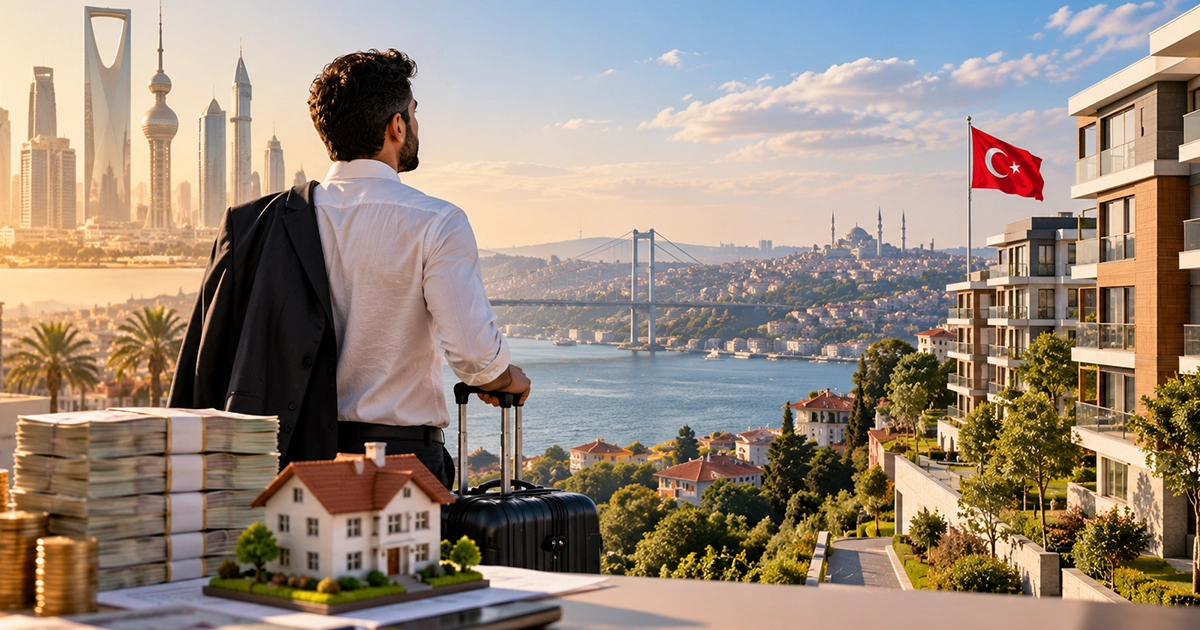
Years of working in the Gulf may provide Egyptian expatriates with a good income and greater ability to save, but the most important question is not simply: How much have you managed to save?
The question that makes the difference in the long term is:
What have you done with those savings?
After years of working in Saudi Arabia, the UAE, Qatar, Kuwait, or other Gulf countries, some expatriates may find that most of their savings remain in the form of cash or liquid assets, while others look for ways to turn part of their expatriate income into a real asset that can be held and benefited from in the future.
This is where interest in real estate investment comes in, particularly in geographically and culturally accessible markets such as Türkiye.
Expatriation Is an Opportunity to Build Capital — Not an End in Itself
For many Egyptians, working in the Gulf represents an important stage in building their future.
The goal may be to purchase a home, establish a business, secure their children’s future, or create an additional source of income before returning to Egypt.
However, relying solely on saving is different from building assets.
Liquidity provides a high degree of flexibility, while an investment asset can serve a different purpose. It may preserve value over the long term and can potentially be used, rented out, or sold in the future.
This is why genuine investment thinking begins when the question changes from:
“How much can I save from my salary?”
to:
“How can I turn part of what I save into an asset?”
Why Are Egyptians in the Gulf Considering Investments Outside Their Country of Residence?
For a large number of expatriates, living in the Gulf is closely linked to employment, and professional or personal circumstances may change in the future.
As a result, some expatriates seek to own assets that are not entirely tied to their current place of employment.
This is where the concept of geographical asset diversification comes into play.
Instead of tying all their savings to a single market, investors can consider distributing their capital among liquidity, different investments, and real estate assets across more than one market, depending on their financial capacity, objectives, and suitable level of risk.
Why Does Türkiye Enter the Egyptian Investor’s Options?
Türkiye is relatively close to Egypt and the Gulf countries and has a broad real estate market offering different options in terms of cities, prices, and property types.
However, investing in Türkiye does not necessarily mean buying property in Istanbul alone.
Other cities can also be considered depending on the investor’s objective and budget, whether the goal is investment, residence, or owning a holiday home.
Foreign investors can also own property in Türkiye in accordance with applicable laws and regulations, making the market accessible to Egyptian investors interested in exploring this option.
Don’t Start with the Property — Start with the Goal
One of the biggest mistakes an investor can make is to begin by asking:
“What apartments are available for sale?”
before determining why they want to buy in the first place.
An Egyptian living in the Gulf should first define the objective.
Does he want a property to hold for 10 years?
Does he want rental income?
Does he want a home that he and his family can use during holidays?
Does he want to invest in an area that is still in a growth phase?
Or does he have greater capital and seek a property that meets the requirements for applying for Turkish citizenship through investment?
The answer can completely change the type of property, location, and budget.
How Can You Turn Part of Your Salary into a Real Estate Asset?
Investment does not necessarily have to begin only when you have the full purchase price of a property in cash.
An expatriate can develop a clear financial plan based on the capital currently available + monthly payment capacity + the investment period.
For example, if you already have some savings and can allocate a fixed portion of your monthly income to investment, certain installment-based projects may be an option worth considering.
This changes the approach:
Instead of waiting for years to accumulate the full value of the property, you can explore the possibility of using an initial down payment to acquire an asset and then gradually complete its value according to a suitable payment plan.
However, the installment terms, total price, delivery date, and legal risks associated with the project must be carefully examined before making a decision.
Real Estate Is Not Simply About Price Appreciation
When evaluating any investment property, there are two potential sources of return:
First: Rental income
If the property is located in an area with genuine rental demand, it may generate regular income that can contribute to improving the overall return on investment.
Second: Future property appreciation
The value of a property may increase as the area develops, infrastructure improves, demand grows, and surrounding services and projects expand. However, such appreciation is not guaranteed, which is why the area and the market should be carefully studied before making a decision.
Therefore, the only question should not be: “How much could the property price increase?”
It should also include questions such as: Is there genuine rental demand? What is the level of demand in this area? What is the quality of the project? What are the maintenance and management costs? And how easy would it be to resell the property in the future?
What Does This Mean for the Egyptian Expatriate?
An expatriate who has worked in the Gulf for years has an important advantage: the ability to build capital gradually.
However, turning that capital into an asset requires a plan, not a quick decision.
The process can begin by determining what percentage of savings can be allocated to investment, then selecting the appropriate market, defining the objective, comparing areas and projects, and studying the payment structure, expected returns, and ownership-related costs.
If Türkiye is chosen, the decision should not be based solely on the property price or marketing promises. Instead, it should be based on a comprehensive set of factors: location, construction quality, price, demand, services, infrastructure, rental potential, and resale potential.
From Monthly Income to a Lasting Asset
The fundamental idea is not for the Egyptian expatriate to stop saving, but rather to think about how to allocate savings in a way that is more closely aligned with future goals.
Part of the money may be allocated to liquidity and emergencies, another part to different investments, and another portion to a real estate asset that can be held over the long term.
In this way, years of working in the Gulf can become more than simply a period of earning a good income; they can become a stage for building real assets for the future.
Ultimately, there is no single investment that suits everyone. A property suitable for someone seeking rental income may not be suitable for someone looking for a family home. Likewise, an investor planning for a ten-year horizon needs a different approach from someone seeking a shorter-term return.
Therefore, before purchasing any property in Türkiye, the investor should define the objective, budget, and investment horizon, then carefully study the available options and make a decision based on actual figures and needs rather than impressions alone.
For the Egyptian expatriate, the years spent working abroad may represent an opportunity not only to accumulate money, but also to turn part of that money into assets that can form a financial foundation for the future.



Join The Discussion