


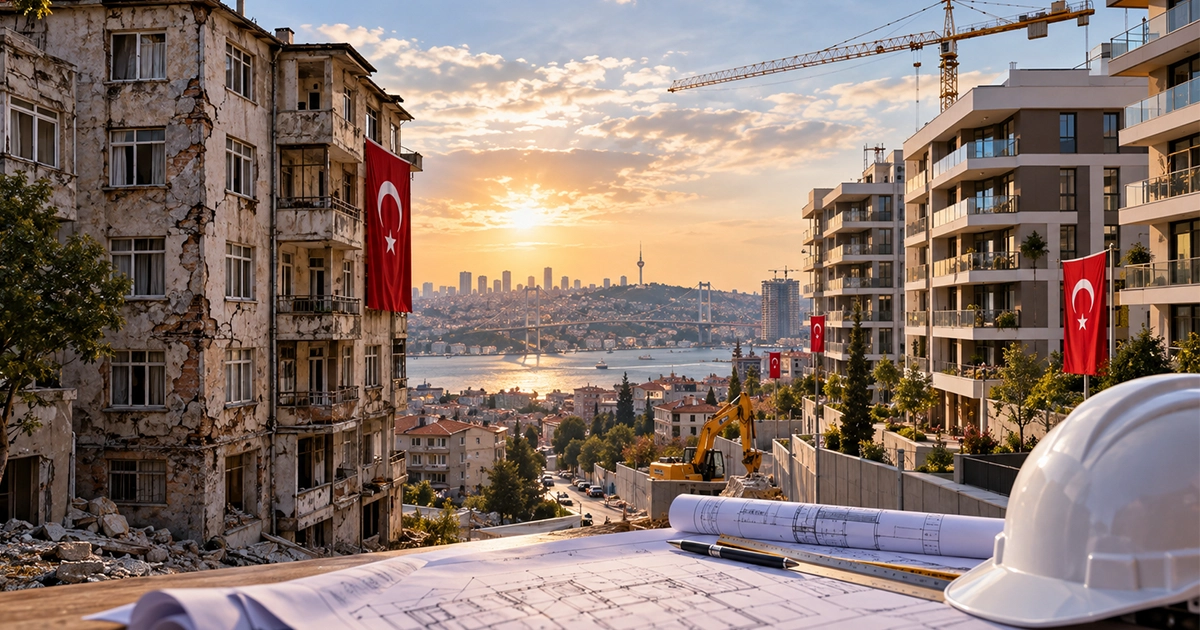
Urban transformation in Türkiye (Kentsel Dönüşüm) has become one of the most important issues in the real estate sector, especially with the growing focus on earthquake-resistant construction and the renewal of old or potentially unsafe buildings.
Urban transformation is not limited to demolishing old buildings and rebuilding them. It also includes assessing structural safety, improving infrastructure, constructing safer buildings according to modern engineering standards, and providing various forms of support and incentives to property owners included in urban transformation programs.
What Does Urban Transformation Mean in Türkiye?
A major part of Türkiye’s urban transformation process is based on Law No. 6306 on the Transformation of Areas Under Disaster Risk.
In general, a risky building is one that has been technically determined to have completed its economic lifespan or to be at risk of collapse or severe structural damage.
Even a single property owner may apply for a Risky Building Assessment (Riskli Yapı Tespiti) without obtaining approval from all other owners. The inspection must be carried out by an institution or organization authorized by the relevant ministry.
How Can You Check the Structural Safety of Your Property?
If you own a property in Türkiye or are considering buying one, you should not rely only on the building’s appearance or age.
It is important to check whether the property has:
- A Building Permit (Yapı Ruhsatı)
- An Occupancy Permit (Yapı Kullanma İzin Belgesi – İskan)
- Approved architectural and engineering plans
- A soil survey report (Zemin Etüdü)
- A suitable foundation system
- Proper concrete and reinforcement standards
- Building inspection records under the Yapı Denetimi system
For older buildings, or when there are concerns about structural safety, obtaining an official engineering assessment is more reliable than simply relying on a visual inspection.
It is also important to remember that the age of a building alone does not automatically mean it is unsafe, just as a newer building should not automatically be considered safe without reviewing its technical documentation and construction quality.
How Is a Risky Building Assessment Carried Out?
A property owner can apply to an authorized institution to carry out a technical inspection of the building.
The assessment generally examines the structural system, load-bearing elements, and relevant engineering data required to determine whether the building is considered risky.
If the building is officially classified as risky under Law No. 6306, legal procedures related to registration, notification, evacuation, and transformation begin.
Property owners have the right to object to the assessment within 15 days from the date of official notification, after which the objection is reviewed by a specialized technical committee.
What Happens After a Building Is Declared Risky?
Once the risky building status becomes final, procedures for evacuation, demolition, or redevelopment begin in accordance with the applicable regulations.
Decisions regarding the redevelopment of the property can, in certain cases covered by Law No. 6306, be made according to the absolute majority of ownership shares.
There are also specific procedures for handling the ownership shares of those who do not agree with the majority decision.
Before signing any agreement with a construction company, property owners should carefully review:
- The size of each new unit and its land share
- Construction start and delivery dates
- Material and construction specifications
- Penalties for delays
- Financial and legal guarantees
- Project permits and approved plans
- The financial and legal standing of the contractor
What Support Is Available Under Urban Transformation Programs?
Law No. 6306 provides several forms of assistance and incentives depending on the property and the eligibility of the owner.
These may include:
- Rental assistance
- Financing or interest support
- Exemptions from certain taxes and administrative fees
Some transactions carried out under the urban transformation framework may also benefit from exemptions related to title deed fees, municipal charges, notary fees, stamp tax, and other costs, depending on the conditions of the transaction.
The amount and conditions of financial support may vary depending on the program, city, and property status. Therefore, official sources should always be checked before calculating expected support as part of a redevelopment budget.
The “Yarısı Bizden” Program in Istanbul
One of the most notable urban transformation support programs is Yarısı Bizden, or “Half Is on Us,” which applies specifically to Istanbul.
Under the program, eligible right holders may receive up to:
- TRY 875,000 in grants
- TRY 875,000 in loans
- TRY 125,000 in evacuation and relocation assistance
This means that total support may reach approximately TRY 1.875 million per eligible residential unit, depending on the program requirements.
The Ministry of Environment, Urbanization and Climate Change has also announced that buildings identified as risky during 2025 and 2026 may be eligible under the program, with the relevant deadline extending to December 31, 2026, subject to applicable conditions.
It is important to note that this program is specific to Istanbul, and the same financial support amounts do not automatically apply to other provinces in Türkiye.
Does Urban Transformation Increase Property Value?
In many cases, replacing an old building with a modern structure that complies with current construction standards can improve the attractiveness and marketability of the property.
However, the new value of a property does not depend solely on the transformation process.
Other important factors include:
- Location
- Size of the new unit
- Construction quality
- Services and facilities
- Transportation access
- Local supply and demand
For this reason, the redeveloped property should be evaluated as a complete real estate investment rather than simply as a replacement for an old building.
Before Buying Property in Türkiye
If you are planning to buy an apartment, especially in an older building, you should not evaluate the property based only on price and location.
Ask to review the building’s legal and technical documents, including the building permit, occupancy permit, title deed, and any records related to urban transformation or risky-building status.
If you already own a property and have concerns about its structural safety, obtaining a technical assessment from an authorized institution is the correct way to determine its actual condition.
Urban transformation in Türkiye is not simply a process of rebuilding old neighborhoods. It is a broader system aimed at improving structural safety, reducing earthquake risk, and enhancing the quality of the urban environment.
For property owners and investors, understanding the condition of the building, legal rights, redevelopment procedures, and available government support can significantly reduce legal, financial, and technical risks.
As urban transformation programs continue throughout 2026, reviewing a building’s structural safety and legal status has become an essential step when evaluating real estate in Türkiye.


Join The Discussion