


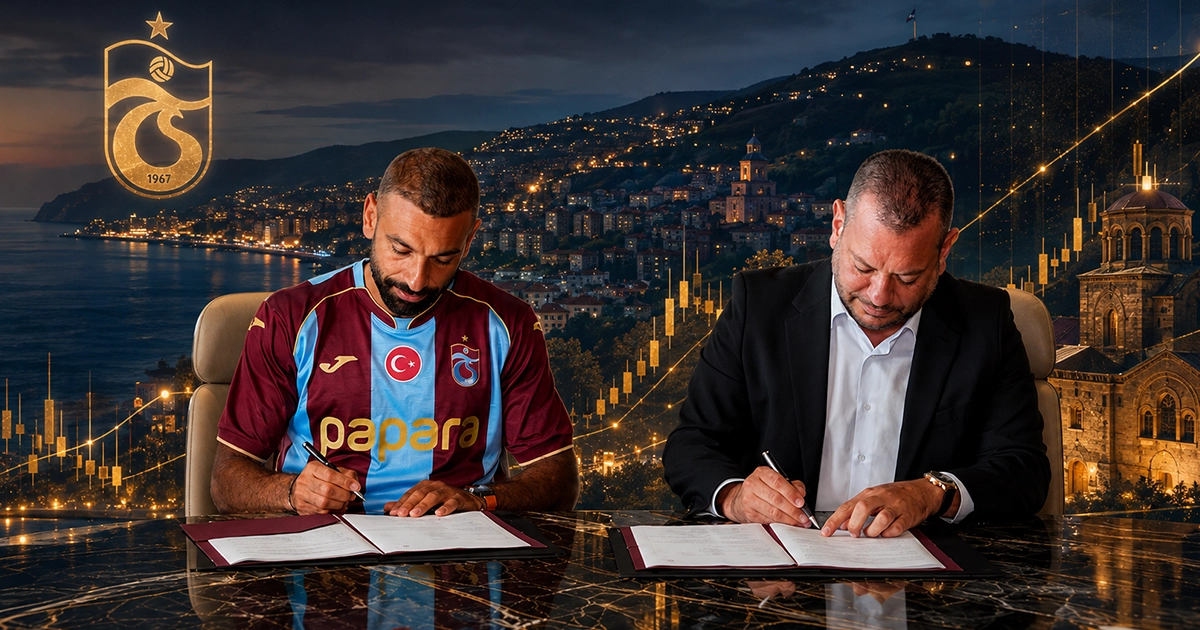
Major football transfers in the modern era are no longer merely technical moves aimed at strengthening a club’s squad. They have become powerful economic tools capable of influencing financial markets, tourism flows, brand value, and even investor sentiment.
From this perspective, Mohamed Salah’s move to Trabzonspor stands out as a transfer that goes far beyond the football pitch, potentially turning into a major economic event with wide-ranging effects.
The first impact was quickly reflected on Borsa Istanbul, where Trabzonspor’s stock, TSPOR, recorded noticeable activity alongside developments surrounding the deal. After falling to around TRY 0.919 on August 3, the share price climbed to approximately TRY 1.030 during the August 5 trading session, representing an overall increase of nearly 12.08% in just three days.
This movement reflects the scale of influence that a global star such as Mohamed Salah can have on the club’s market value and on investor confidence in its brand, particularly as media and fan interest grows both inside Turkey and internationally.
The economic effect is not limited to the stock market. It also extends directly to the club’s operating revenues. Demand for match tickets and season subscriptions is expected to rise significantly, alongside increased sales of Salah jerseys and other products through TS Club, particularly across Arab markets, the Middle East, and North Africa.
Salah’s presence in the Turkish league could also increase the commercial value of Trabzonspor’s matches and enhance the appeal of international broadcasting rights in markets that previously did not follow the club with the same level of interest.
The player’s vast fan base in Egypt, the Arab world, and Europe represents a new audience that can be transformed into commercial value not only for Trabzonspor, but also for the Turkish Süper Lig as a whole.
The broader impact could be felt across the city of Trabzon itself. The city is already considered one of Turkey’s most popular destinations among Arab tourists and investors, and the presence of a global star of Salah’s stature could provide an additional boost to its tourism profile.
Football matches may become a direct reason for fans to visit the city, creating positive effects for hotels, restaurants, airlines, car rental companies, and tourism-related businesses.
With more visitors and increased international media attention, the real estate sector could also benefit from Trabzon’s growing visibility among Arab investors.
The commercial value of the transfer may also open the door to new sponsorship agreements, whether from Turkish companies or regional and global brands seeking to benefit from Salah’s enormous international reach.
This is where what can be described as an “economic butterfly effect” begins to emerge: a football transfer starts within the walls of a club, then spreads to the stock market, retail sales, advertising, and television broadcasting, before reaching tourism, real estate, and investment.
Ultimately, a transfer of this magnitude offers a clear example of how sports investment can evolve into a fully integrated economic tool.
If Trabzonspor succeeds in converting the excitement surrounding Mohamed Salah into long-term commercial and media value, the real gains from the deal could ultimately be far greater than the number of goals he scores on the pitch.
By Abdelaziz El-Kashef



Join The Discussion