



By: Abdülaziz KAŞİFOĞLU
In the world of investment, wealth is measured not only by its size, but also by its ability to withstand economic shifts and unexpected crises.
An investor may own a successful company, income-generating real estate, a stock portfolio, and cash reserves, believing that these assets provide sufficient diversification. But the more important question is this: What if all these investments are linked to a single economy or geographical region and are exposed to the same economic factors?
This highlights one of the most important principles of modern wealth management: genuine diversification is not only about the types of assets we own, but also about their geographical locations, sources of income, and the extent to which they are exposed to the same risks.
The economic and geopolitical developments that affected the Gulf region in 2026 have brought this question to the forefront, prompting investors to reconsider strategies for protecting capital and sustaining long-term growth.
The 2026 Shock: When Strong Economies Face Exceptional Challenges
Developments in 2026 affected economic growth forecasts for several countries in the region amid disruptions to energy supplies, trade flows, and international maritime transport.
According to economic estimates circulating in October 2026 and attributed to the International Monetary Fund (IMF), projected economic contractions reached approximately 16.7% in Kuwait and 15.6% in Qatar, although the expected impact varied across the region’s economies.
It is important to emphasize that these figures represent economic forecasts that remain subject to revision, rather than final outcomes. They also do not mean that the value of all assets will decline or that investors will necessarily incur direct losses at the same rates.
The Gulf countries have influential economies, substantial financial reserves, sovereign wealth funds, and advanced infrastructure. They also have strategic plans to diversify income sources and strengthen non-oil sectors.
However, economic experience demonstrates that a strong economy does not necessarily mean an absence of risk. External shocks can affect even the most stable markets.
This highlights the importance of considering how investments can be distributed in ways that reduce the impact of regional crises on overall wealth.
Why Is Diversifying Investments Within a Single Market Not Enough?
Let us imagine a Gulf investor who owns a construction company, several rental properties, a portfolio of locally listed stocks, and cash deposits in banks.
At first glance, the portfolio appears diversified.
However, if the company depends on domestic spending, the rental properties are leased to individuals and businesses affected by the same economic activity, and the stock portfolio includes shares in banks and companies linked to the domestic market, a significant portion of the investor’s wealth remains exposed to a similar set of risks.
This is where the distinction between diversifying asset classes and diversifying sources of risk becomes essential.
Owning different types of assets does not necessarily mean having a balanced investment portfolio.
For this reason, strategic wealth management rests on three main dimensions:
- Geographical diversification: Distributing investments across different markets and economic regions.
- Sectoral diversification: Investing in multiple industries and activities, such as real estate, manufacturing, trade, and services.
- Financial diversification: Balancing liquidity, returns, financial obligations, and currency risks.
When these dimensions complement one another, investors become better equipped to navigate economic fluctuations without relying entirely on the performance of a single market.
The Gulf as a Major Economic Hub: Diversification as an Extension of Success
Over recent decades, the Gulf countries have undergone significant economic transformations and established investment environments that attract both domestic and international capital.
Saudi Arabia is expanding its industrial, tourism, services, and technology sectors as part of its economic vision. The United Arab Emirates, meanwhile, holds an established position in trade, financial services, transport, and tourism, while Qatar continues to develop its investments in energy, infrastructure, and other economic sectors.
These strengths make Gulf markets an essential component of any long-term investment strategy.
Nevertheless, wealth management is not about choosing one market as the best option under all circumstances. It is about building a portfolio that benefits from opportunities across more than one economy.
The objective is not to move investments away from the Gulf, but to broaden investment horizons by considering other markets with different economic characteristics, thereby supporting balance and long-term sustainability.
Why Does Turkey Deserve a Place on the Investment Diversification Map?
When examining markets suitable for geographical diversification, Turkey stands out as one of the region’s major economies, combining a diversified production base, a large consumer market, and a strategic geographical position connecting Asia and Europe.
Turkey’s economic appeal rests on several factors that deserve investors’ attention.
A Large Economy and an Extensive Domestic Market
According to World Bank data cited in the reference material, Turkey’s gross domestic product (GDP) reached approximately $1.60 trillion, with a population of around 85.9 million.
These indicators reflect the scale of economic activity and the size of the domestic market, together with the continuing demand for housing, trade, services, and production.
Economic activity in Turkey does not depend on a single sector. Instead, it is distributed across multiple industries that offer a variety of investment opportunities.
A Diversified Industrial and Production Base
Turkey has an industrial base covering automotive manufacturing, machinery, textiles, food processing, and chemicals, alongside extensive commercial and logistics activities.
This diversity helps generate multiple sources of economic activity and demand for commercial, industrial, and residential real estate.
Furthermore, Turkey’s connections with European and Asian markets give it an important role in regional and international production and supply chains.
Active Agricultural, Tourism, and Services Sectors
Turkey benefits from diverse agricultural and food production, a substantial tourism industry, and a wide range of service and commercial activities.
These sectors help support economic activity, create employment opportunities, and generate demand for real estate in cities and regions benefiting from population growth, commercial expansion, and tourism.
Nevertheless, the size and diversity of the Turkish economy do not eliminate risks associated with inflation, interest rates, and exchange-rate fluctuations. These factors must be incorporated into any serious investment assessment.
Real Estate Investment in Turkey: Beyond Price Appreciation to Understanding Actual Demand
When discussing real estate investment in Turkey, the most important question is not how much property prices might rise in the coming years, but which factors generate demand and support property values over the long term.
The real estate market is influenced by several variables, including population growth, business activity, infrastructure development, purchasing power, the availability of services, and employment opportunities.
Consequently, residential, commercial, industrial, and tourism-related properties have different investment characteristics.
Residential properties derive a significant portion of their demand from the housing needs of households and residents. Commercial and industrial properties, meanwhile, are more closely linked to business activity, production, and logistics services.
In my view, successful real estate investment begins with understanding the market before selecting a property.
It is not enough to rely on expectations of rising prices. Investors should examine actual rental yields, maintenance and management costs, potential vacancy rates, tax obligations, and expected liquidity when reselling the property.
Returns should also be assessed after accounting for inflation and currency fluctuations, particularly for investors who measure their wealth in US dollars or Gulf currencies.
Yalova: A Model for Real Estate Opportunities Linked to Economic Development
When examining Turkey’s real estate investment landscape, the city of Yalova deserves particular attention, not only because of its natural surroundings and location on the Sea of Marmara, but also because of its proximity to major economic and industrial centers.
Yalova is situated within a geographical area connected to Istanbul, Bursa, and Kocaeli, regions characterized by substantial industrial, commercial, and population activity.
The province is also experiencing development in its organized industrial zones, alongside tourism and urban development.
These factors make an assessment of Yalova’s real estate market relevant from several perspectives: residential demand, demand associated with economic activity, and properties intended for seasonal living and leisure.
Nevertheless, selecting the right investment requires evaluating each project individually, taking into account its location, construction quality, services, infrastructure, legal status, and potential for rental income and resale.
An investment opportunity should not be judged by the name of the city alone, but by the ability of the property to meet genuine demand and fulfill the investor’s objectives.
How Can We Build a More Balanced Real Estate Portfolio?
I believe the current environment requires investors to view real estate as part of a broader wealth-management strategy, rather than simply as a means of achieving rapid capital gains.
When considering the addition of a property outside the domestic market, the first step should be to define the investment objective clearly.
Is the goal to generate regular rental income? To hold a long-term asset? Or to own a property for personal and family use while retaining the potential to benefit from its future value?
The answer differs from one investor to another. The appropriate allocation also depends on the size of the portfolio, available liquidity, financial obligations, and risk tolerance.
It is equally important to examine real estate regulations, verify the validity of title deeds, assess construction standards and earthquake safety, and account for fees, taxes, and property management costs.
In this context, working with a real estate developer that has local market experience can be an important factor in helping investors understand the market and evaluate available options.
Property Management After Purchase Is Part of Investment Success
One common mistake is to reduce real estate investment to the purchase transaction alone.
A property is an asset that requires ongoing attention, whether in terms of maintenance, expense management, tenant relations, or evaluating resale opportunities.
These considerations become even more important when an investor lives outside Turkey and cannot personally oversee day-to-day operations.
At Omran TRK, we therefore believe that the relationship with an investor should not end when the property is handed over. It should extend into the post-sale period through property follow-up, management, maintenance, and assistance with resale according to the owner’s needs.
Effective property management helps preserve an asset’s operational value and improve the ownership experience. However, it remains part of a broader investment framework that requires planning, monitoring, and continuous evaluation.
What Lessons Should We Draw from 2026?
Economic and geopolitical shifts reinforce several principles that I consider fundamental to wealth management.
First: A strong economy does not mean an absence of risk. Even major economies can face external shocks that affect economic activity and financial markets.
Second: Domestic diversification alone may not be sufficient. If all assets are linked to the same economic factors, they may be affected simultaneously during a crisis.
Third: Geographical diversification is a risk-management tool. Allocating a carefully considered portion of investments to different markets may help reduce concentration risk, while investors must remain aware of the new risks associated with each market.
Fourth: Investment quality matters more than the speed of decision-making. Feasibility studies, actual returns, legal status, and asset quality are more important than marketing promises and unsubstantiated forecasts.
Fifth: Wealth management is an ongoing process. A strategy that was appropriate several years ago may need to be reviewed as economic conditions and financial objectives change.
Conclusion: Sustainable Wealth Requires a Vision Beyond Borders
Economic experience does not call on us to question the strength of the markets that have contributed to our success. Rather, it encourages us to improve the way we manage that success.
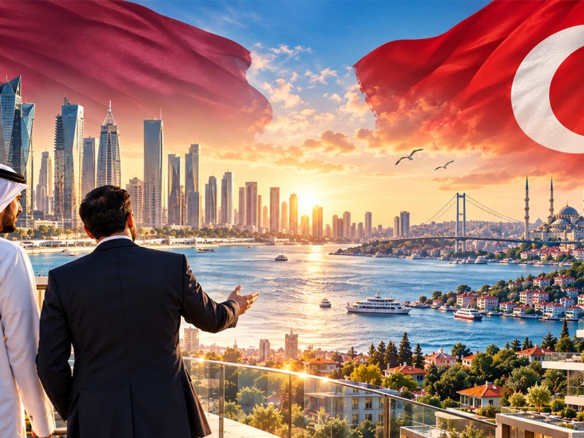
The Gulf countries will remain important economic and investment hubs, while other markets, particularly Turkey, offer opportunities worth examining as part of a balanced geographical diversification strategy.
Based on my experience in Turkey’s real estate sector, I believe that sound investment decisions should not begin by asking which market offers the highest return. Instead, investors should ask which market and which asset best align with their objectives, risk tolerance, and long-term plans.
True wealth is not merely what we succeed in building, but what we manage to protect and grow for future generations.
Abdülaziz KAŞİFOĞLU
Omran TRK
Sources and References
- International Monetary Fund (IMF): World Economic Outlook, October 2026.
- World Bank: Economic indicators for Turkey.
- Turkish Statistical Institute (TurkStat): Gross domestic product data.
- Al Jazeera: Coverage of economic forecasts for Gulf countries, October 13, 2026.
Editorial note: The cited contraction figures are forecasts rather than final annual results and should be checked against the original IMF publication before publication.


Join The Discussion