


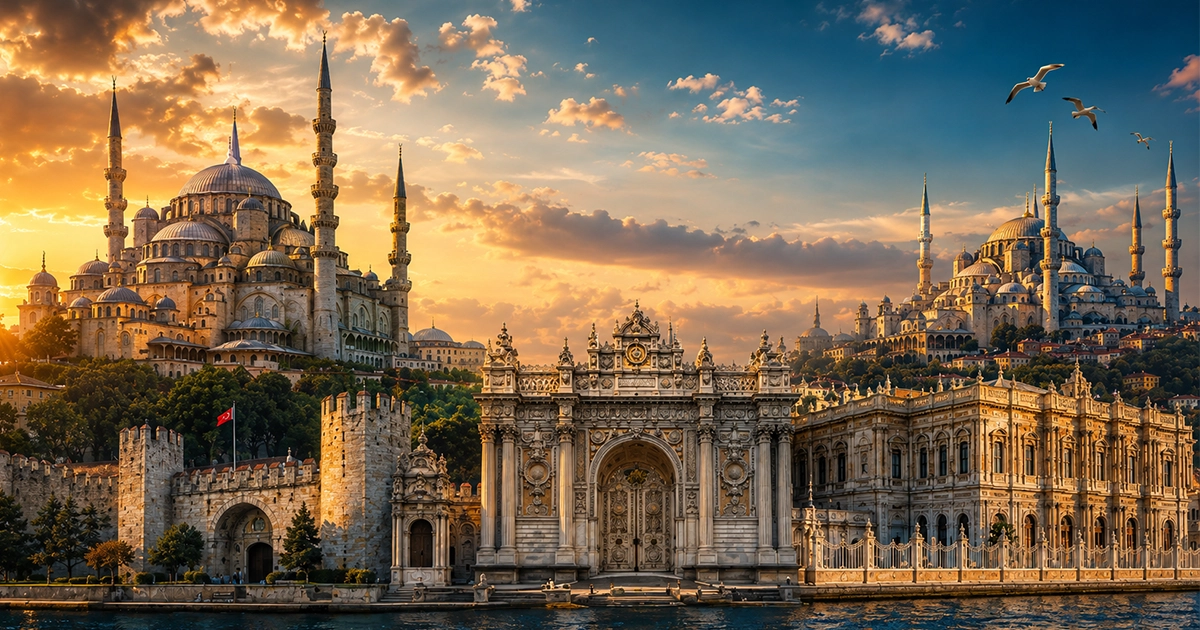
Walking through Istanbul, its historic Ottoman buildings are more than beautiful landmarks or tourist attractions. They can be read as pages from the history of the Ottoman Empire. Palaces, mosques, courtyards, and monumental complexes reveal how the empire evolved over the centuries—from the establishment of a new capital after the conquest of Constantinople, through its period of power and prosperity, to the growing influence of European architectural styles in the nineteenth century.
Understanding Ottoman architecture in Istanbul therefore offers visitors a different way to experience the city. Almost every major building tells a story about the politics, religion, art, and social life of its era.
Topkapı Palace: When Istanbul Became the Center of the Empire
Following the conquest of Istanbul, Sultan Mehmed II ordered the construction of Topkapı Palace. Built between 1460 and 1478, the palace was later expanded by successive Ottoman sultans.
For centuries, Topkapı served as both the administrative center of the empire and the residence of the Ottoman sultans, until the imperial court moved to Dolmabahçe Palace in the nineteenth century.
The importance of Topkapı Palace lies not only in its grandeur, but also in the way its courtyards, pavilions, administrative chambers, and private quarters reflect the structure of the Ottoman state itself.
It stands as an architectural witness to the period when Istanbul was transformed into the political and administrative capital of a vast empire.
Süleymaniye Mosque: Architecture at the Height of Ottoman Power
If Topkapı Palace represents the establishment of Istanbul as an Ottoman capital, the Süleymaniye Mosque represents another phase: the height of Ottoman confidence and power during the sixteenth century.
Commissioned by Sultan Süleyman the Magnificent and designed by the celebrated imperial architect Mimar Sinan, Süleymaniye became one of the most important monumental mosques in Istanbul.
Its domes, courtyards, minarets, and carefully balanced proportions are not merely decorative. They reflect the ambition of an empire that sought to express its political and cultural power through architecture.
The great Ottoman complexes were also deeply connected to everyday urban life. Architecture was not separated from society; it was an essential part of the city’s religious, educational, and social structure.
Sultan Ahmed Mosque: Istanbul as a Stage of Imperial Prestige
Roughly a century later came the Sultan Ahmed Mosque, internationally known as the Blue Mosque.
Built between 1609 and 1616 under Sultan Ahmed I, the mosque was designed by Sedefkâr Mehmed Ağa, an architect influenced by the tradition established by Mimar Sinan.
Its six minarets, monumental proportions, and rich interior decoration featuring İznik tiles made it one of the most recognizable examples of Ottoman imperial architecture.
Here, architecture continued to serve as a symbol of state prestige.
Its location opposite Hagia Sophia in the historic Sultanahmet district also created one of Istanbul’s most remarkable architectural landscapes, where Byzantine and Ottoman history meet within the same urban space.
Dolmabahçe Palace: The Empire Looks Toward Europe
To understand the major transformation experienced by the Ottoman Empire in the nineteenth century, Dolmabahçe Palace is one of the clearest architectural examples.
Built during the reign of Sultan Abdülmecid I and completed in the mid-nineteenth century, the palace became the new center of imperial life after the Ottoman court moved away from Topkapı Palace.
Architecturally, the difference is striking.
While Topkapı reflects a more traditional Ottoman organization based on courtyards and separate pavilions, Dolmabahçe combines Ottoman traditions with strong European influences, including Baroque, Rococo, and Neoclassical elements.
In this sense, the palace becomes almost a political document in architectural form. It reflects the empire’s efforts to redefine its image and engage more closely with the cultural and political transformations taking place in Europe.
From Topkapı to Dolmabahçe: The History of an Empire Written in Stone
When these buildings are considered together, they reveal the development of the Ottoman Empire across different periods.
Topkapı Palace represents the establishment of the imperial capital.
Süleymaniye Mosque reflects the confidence and power of the classical Ottoman age.
Sultan Ahmed Mosque continues the tradition of monumental imperial architecture.
And Dolmabahçe Palace reveals a later period in which European influences became increasingly visible.
Their architecture, functions, and historical contexts allow us to trace the changing character of the empire through the buildings themselves.
Istanbul: An Open-Air Museum of Ottoman Architecture
From Topkapı Palace and Süleymaniye Mosque to the Blue Mosque and Dolmabahçe Palace, Istanbul offers a rare opportunity to experience several centuries of Ottoman history within a single city.
Exploring historic Istanbul is therefore more than a journey between old monuments. It is a journey through the rise, transformation, and changing artistic identity of an empire.
Domes, minarets, courtyards, decorative tiles, waterfront palaces, and even the arrangement of rooms all contain clues about the politics, society, and culture that shaped Istanbul.
Ottoman architecture in Istanbul does not remain silent.
It tells the story of the city—and the story of an empire that continues to shape Istanbul’s identity today.


Join The Discussion